Invoicing
An invoice that has been checked before anybody else checks it.
Invoicing is where this product started and where the most work has gone. Everything on this page is something you can click on today.
-
The draft
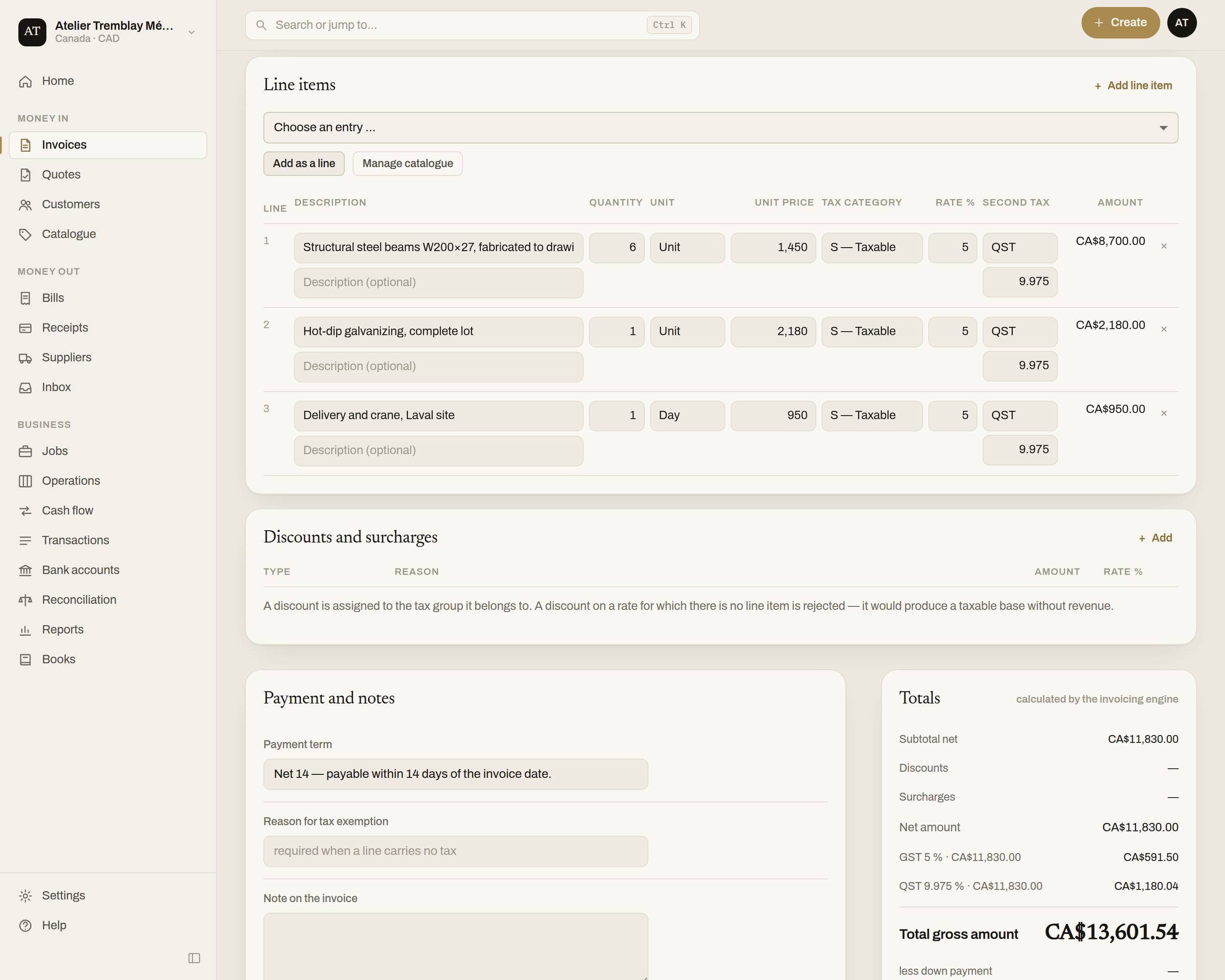
Lines with quantity, unit, unit price and discount, optionally pulled from your own catalogue. Mixed tax rates, a zero rate and reverse charge on one invoice are ordinary cases. The totals are computed by the engine, not by the form — the same arithmetic that later produces the XML.
-
The tax comes from the country
Which rates are lawful, what wording an exemption must carry and what a tax number looks like are decided by the country, not by a list in the interface. Where the software cannot know the rate because it depends on facts it does not hold, it does not invent one: in the United States you enter it, and the arithmetic uses what you entered.
-
Validated before it is issued
Before issuance the invoice runs through the European standard EN 16931 and through your country's own rule sets. If it fails it is not issued, and you see which rule it broke. Nothing leaves unvalidated — and what passes carries the record of that permanently.

-
Electronic invoicing, in the country's own format
Germany: ZUGFeRD/Factur-X inside a PDF/A-3, carrying the XML unmodified. France: Factur-X. Belgium: Peppol BIS UBL. Poland: FA(3). Canada and the United States have no such obligation and are therefore not handed a European format. What happens here is that the file is produced and checked — handing it to a network, a platform or KSeF is not part of it and is claimed nowhere. Where a country cannot do something, the software says so rather than shipping something similar.
-
Issued means unalterable
An issued invoice is never touched again. It sits in the archive as a snapshot, with a checksum and its validation record, carrying the recipient's details exactly as they read at the moment of issuance — a later edit to the customer record does not change it. A correction is a document of its own with a number of its own.
-
Sent, and then due
The invoice goes out by email with the XML, the PDF and optionally a payment link. „Overdue“ is not a stored flag but a comparison with today's date and with what is genuinely still outstanding — so it cannot go stale and cannot be wrong.
Create an account and write one invoice.
You need the country your business is registered in and ten minutes. Everything else — company details, chart of accounts, number ranges — comes into being as you go.