Accounting
Underneath everything sits a double-entry ledger.
Not as an upgrade and not as a report bolted on top, but as the place every event lands. That is why the numbers you look at are the numbers you eventually file.
-
Debit and credit
Issuing, payment, refund, chargeback, fee and supplier bill each produce their own entry, and no entry is altered afterwards. A correction is a reversing entry — both stay readable, because both happened.
-
The chart of accounts comes from the country
When you open the books you choose a currency and a chart of accounts. Which charts are on offer is decided by your country; where no national chart is carried there is a small neutral one to work with honestly, rather than a foreign one pretending to fit.
-
Periods
A financial year is opened and periods can be closed. Nothing is posted into a closed period — not because a screen forbids it, but because the service behind it refuses, whoever is asking.
-
Reports
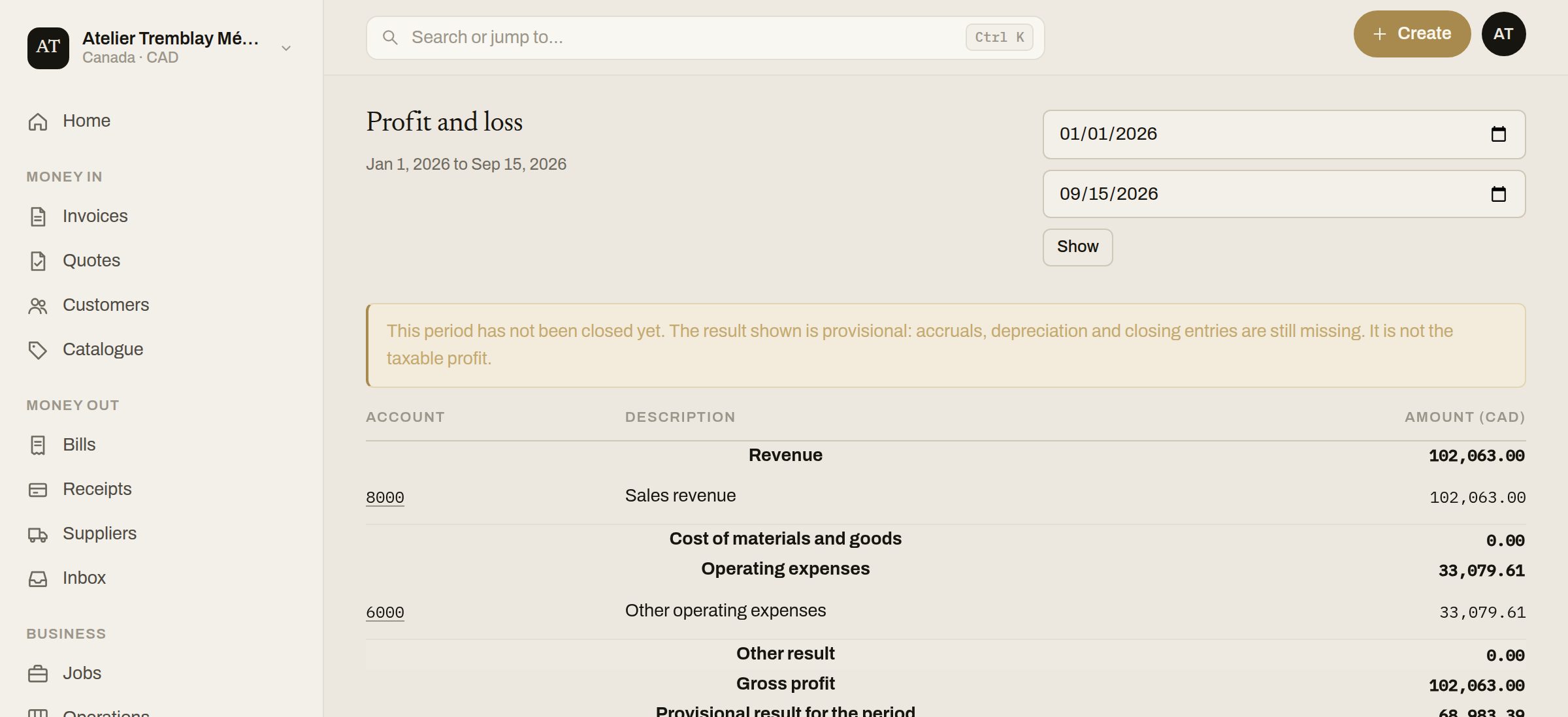
Trial balance, profit and loss, balance sheet, and an ageing analysis for receivables as well as payables. Every figure can be opened until you reach the individual entry and, from there, the document. While a period is not closed, the report says so at the top instead of presenting a result as though it were the taxable profit.
-
Expenses and receipts
Record expenses, attach the receipt and keep it unaltered. Once attached it stays permanently tied to the record — including after the record is later corrected.
-
Supplier bills
Your suppliers' invoices arrive in an inbox, are read out, reviewed and then become a payable. What the software read out of a file and what a person typed stays distinguishable field by field — so that nobody mistakes an automatically extracted amount for a confirmed fact.
-
Moving in from elsewhere
Customers, suppliers, products and services, open items and opening balances can be brought in from files: upload, map the columns, review row by row, then commit — and not before.

The bank
Bank connectivity: built, but not signed off yet.
Payments are recorded in KRONENWERK by hand or confirmed by the payment provider, and the posting follows from that. Bank credentials never reach KRONENWERK.
Create an account and write one invoice.
You need the country your business is registered in and ten minutes. Everything else — company details, chart of accounts, number ranges — comes into being as you go.